Medical Device Startup Operations: 10 Costly Inventory Mistakes to Avoid
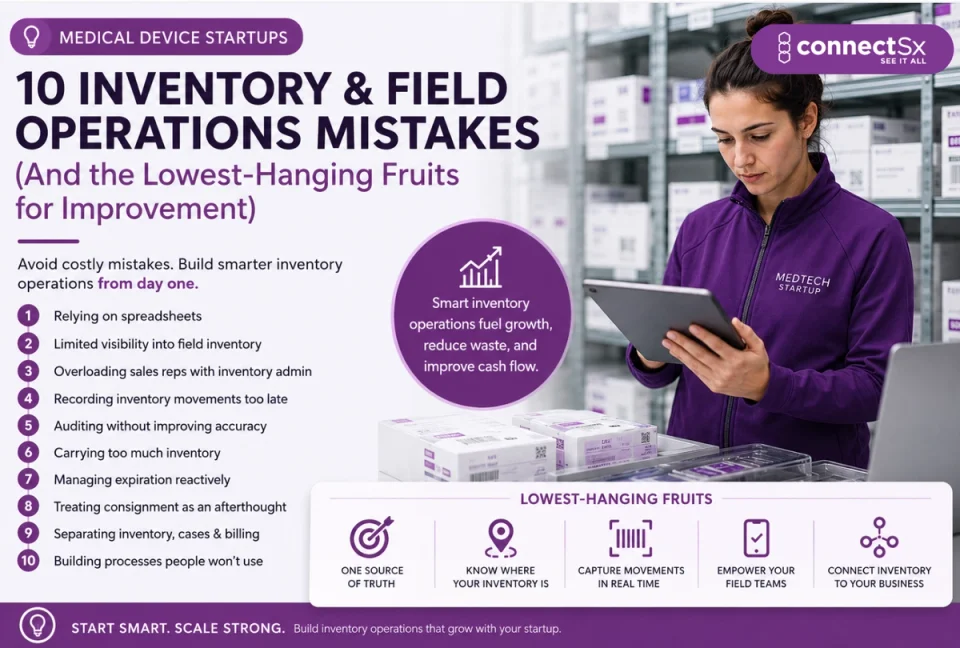
For a growing medical device startup, scaling field operations is one of the most challenging hurdles during commercialization. What works when managing a few sales representatives and local accounts quickly breaks down when products scatter across regional warehouses, sales rep vehicles, hospital consignment closets, and surgical centers.
Spreadsheets multiply, audit discrepancies increase, sales reps waste hours tracking loaner kits, and finance experiences billing delays waiting for manual case consumption records.
Manufacturer ➔ Central Warehouse ➔ Distributor / Rep Vehicle ➔ Hospital Consignment ➔ Surgical Case ➔ Billing
To build a scalable foundation, every medical device startup must eliminate manual tracking early and adopt automated field inventory control.
At a Glance: Mistakes vs. Low-Hanging Fruit Fixes
| Operation Mistake | Impact on a Medical Device Startup | Low-Hanging Fruit Solution |
|---|---|---|
| 1. Spreadsheet Reliance | Version conflicts, zero field visibility, manual errors | Centralize data into one single source of truth. |
| 2. Field Blind Spots | Lost trunk stock, write-offs, missing consignment items | Assign real-time locations and statuses to every item. |
| 3. Administrative Rep Burden | Less time selling, high human error rate | Deploy fast mobile scan-and-confirm workflows. |
| 4. Delayed Data Entry | System records lag physical movement by days | Capture transactions live at the point of action. |
| 5. Audit-First Mindset | Reactive firefighting instead of continuous accuracy | Implement mobile cycle counts and exception alerts. |
| 6. Excessive Field Stock | Trapped working capital, high expiration risk | Right-size territory par levels using historical usage data. |
| 7. Reactive Expirations | Costly write-offs from expired products | Automate First-Expired, First-Out (FEFO) field transfers. |
| 8. Neglected Consignment | High shrinkage, low inventory turns | Track consignment accounts as formal stocking locations. |
| 9. Siloed Billing Workflows | Delayed cash flow, uncaptured usage | Link surgical usage directly to billing triggers. |
| 10. Overly Complex Tools | Poor employee adoption, workarounds, missing data | Implement mobile-first, zero-friction tools. |
Why Every Medical Device Startup Struggles with Field Inventory
Field operations for a medical device startup are uniquely complex. Unlike traditional retail supply chains, products move into a fluid network:
- Central Warehouse: Initial receiving and staging.
- Sales Rep Vehicles (Trunk Stock): Mobile inventory carried directly by reps.
- Distributor Stock: Third-party storage and fulfillment.
- Hospital & Surgery Center Consignment: On-site stock waiting for surgery.
- Loaner Kits: Shared sets moving between accounts for specific procedures.
Knowing what inventory your medical device startup owns is not the same as knowing where that inventory physically is.
10 Critical Field Inventory Mistakes To Avoid
1. Using Spreadsheets as the Primary Inventory System
Spreadsheets are cheap and accessible, making them a common starting point for an early-stage medical device startup. However, using static sheets to manage a dynamic supply chain inevitably leads to fragmented records, where sales reps, operations, and finance all view different versions of reality.
- The Fix: Create a single source of truth. Standardize every item movement: Receive ➔ Assign ➔ Transfer ➔ Use ➔ Return ➔ Replenish. Dedicated platforms like ConnectSx Beacon centralize these workflows in real time.
2. Maintaining Poor Visibility Into Field Stock
Inventory rarely stays inside the central warehouse. Trunk stock in sales vehicles, consignment items in hospital closets, and loaner sets in transit create dangerous operational blind spots if untracked.
- The Fix: Give every asset a specific, trackable location and status (e.g., Warehouse, Rep Trunk, Consignment, In-Transit, Surgical Case Reserved, or Used).
3. Overburdening Sales Representatives with Admin Tasks
Sales reps at a medical device startup should spend their time supporting procedures, building surgeon relationships, and driving revenue—not updating spreadsheets. Manual entry leads to rep burnout and inaccurate data.
- The Fix: Replace manual data logging with mobile barcode and Unique Device Identification (UDI) scanning. A mobile-first workflow allows reps to complete transfers in seconds: Scan ➔ Confirm ➔ Complete.
4. Logging Inventory Movements Days After They Happen
When a sales rep transfers inventory on Monday but logs it on Thursday, system records lag behind reality. This delay causes double-booking, stockouts, and unnecessary emergency freight costs.
- The Fix: Capture transactions live at the point of physical movement using mobile barcode scanning.
5. Relying on Audits Instead of Continuous Accuracy
Physical inventory audits verify system accuracy; they do not create it. If periodic audits uncover major discrepancies, the underlying transaction process is broken.
- The Fix: Transition to continuous inventory accuracy using mobile cycle counting, automated exception reports, and complete transaction histories.
6. Carrying Excessive Buffer Stock in the Field
To prevent stockouts during procedures, a medical device startup will often over-allocate field stock. Carrying excess inventory ties up vital working capital and increases exposure to expiration losses.
- The Fix: Establish territory par levels based on actual utilization rates, historical case demand, and local lead times.
7. Managing Product Expirations Reactively
Discovering an expired high-value device in a hospital closet forces an immediate financial write-off. Passive tracking directly hurts profit margins.
- The Fix: Automate First-Expired, First-Out (FEFO) alerts. Prompt field transfers from low-volume accounts to high-volume accounts months before products reach their expiration dates.
8. Treating Consignment Accounts as an Afterthought
Consigned inventory located at customer facilities remains company-owned capital. Neglecting consignment accounts leads to high shrinkage and poor asset turnover.
- The Fix: Track consignment locations as formal stocking accounts. Monitor replenishment rules, expiration dates, and account utilization rates. Verify serial numbers in the field alongside official regulatory frameworks like the FDA AccessGUDID Database.
9. Separating Inventory Management From Billing
When surgical case logs, inventory movement, and billing processes live in separate systems, manual handoffs slow down cash flow and cause unbilled usage.
- The Fix: Connect field workflows into a unified chain:
$$\text{Surgical Case Capture} \longrightarrow \text{Inventory Depletion} \longrightarrow \text{Automated Billing} \longrightarrow \text{Replenishment Trigger}$$
This integration ensures fast revenue capture for a growing medical device startup.
10. Forcing Complex Tools on Field Personnel
Software designed exclusively for desktop computers fails in hospital operating rooms. If a tool requires excessive administrative steps, field personnel will find workarounds.
- The Fix: Build workflows tailored to the actual field environment. Ensure tools work on mobile devices, support quick scanning, and function seamlessly offline in hospital basements.
Scaling Operations with ConnectSx Beacon
For a medical device startup, achieving operational control does not require an enterprise software overhaul. It requires a flexible system built for field logistics.
ConnectSx Beacon is engineered specifically for medical device manufacturers, distributors, and field reps:
- Centralized Real-Time Visibility: View inventory across warehouses, sales reps, distributors, and consignment locations in one dashboard.
- Mobile-First Scanning: Enable field reps to perform UDI barcode scanning, inventory transfers, and audits directly from mobile devices.
- Consignment & Field Control: Maintain full oversight of field stock and customer consignment levels to protect working capital.
- Connected Case & Billing Workflows: Link surgical usage directly to billing and replenishment, eliminating manual handoffs and speeding up cash flow.
- Proactive Expiration Tracking: Receive automated alerts to reallocate expiring assets before they result in write-offs.
Frequently Asked Questions
Why is field inventory tracking critical for a medical device startup?
A medical device startup operates with lean capital. Lost trunk stock, untracked consignment, or expired products directly reduce margins and disrupt surgical support.
How does mobile barcode scanning assist a medical device startup?
Mobile UDI barcode scanning replaces manual data entry with instant mobile verification. Reps scan items in seconds, instantly updating central inventory and reducing data entry errors.
Can a medical device startup avoid implementing a complex ERP early on?
Yes. Purpose-built field management platforms like Beacon provide targeted inventory, case, and consignment tracking without the high cost and implementation friction of complex enterprise ERP systems.
Building Scalable Field Operations
Scaling a requires operational clarity. By replacing spreadsheets with real-time field tracking, simple mobile workflows, and integrated billing triggers, growing companies protect working capital and ensure field sales reps remain focused on revenue growth.
Take Control of Your Field Operations with Beacon
Scaling a medical device startup does not require expensive enterprise software overhauls or bloated administrative overhead. ConnectSx Beacon gives growing medtech companies complete control over field inventory, trunk stock, consignment accounts, and surgical case workflows in one simple platform.
See How Much You Can Save
Unclear field visibility costs the average growing medical device business thousands of dollars monthly in lost items, emergency freight, and expired stock.
- Calculate Your Savings: Try our free Beacon ROI Calculator to see exactly how much working capital your startup can unlock.
- Experience Beacon Live: Ready to streamline your field operations? Get a Free Trial of Beacon today and see how easy real-time field control can be.
Brendan Sweeney
ConnectSx Team
Ready to streamline your operations?
See how Beacon can transform your medical device workflows.