The ROI of Medical Device Field Inventory Management
The medical device field inventory management ROI conversation rarely gets started — not because the numbers are unclear, but because no one has built the financial case. This article does exactly that. If your company deploys reps, distributors, or hospital consignment inventory, the devices sitting in the field represent significant working capital and significant financial risk. Companies that manage this well consistently outperform on gross margin, working capital efficiency, and revenue capture. Those that rely on spreadsheets and manual processes quietly absorb losses that never surface as a single line item — but show up everywhere in the P&L.
This article lays out the full financial case for field inventory management: the cost drivers, the ROI benchmarks, the comparison between common tracking approaches, and a step-by-step model for quantifying the return on your own operation.
📊ROI CALCULATOR INCLUDED — A Field Inventory Management ROI Calculator is included at the end of this article. Use it to build a customized financial case for your leadership team or CFO review.
What Is Field Inventory Management in Medical Devices?
Field inventory management refers to the processes, systems, and controls that govern medical devices and instruments once they leave the warehouse and enter the field — in the hands of sales reps, distributors, or stored on consignment at hospital and surgical center locations.
Unlike warehouse inventory, field inventory is distributed, dynamic, and often tracked outside of core ERP systems. It includes:
- Loaner and consignment trays at hospital and ASC locations
- Rep trunk stock and demo inventory
- Distributor-held inventory earmarked for specific territories or accounts
- Instrument sets staged for upcoming surgical cases
The challenge is visibility. Without real-time data on what is where, how much is being used, and what is approaching expiration, companies are making purchasing, deployment, and billing decisions based on incomplete information — and paying for it.
The Hidden Financial Cost of Poor Field Inventory Management
Field inventory does not leak value in one obvious way — it leaks across six categories simultaneously. Understanding each is the foundation of a credible financial case for inventory management.
Excess Stock and Carrying Costs
Over-building field sets 'just in case' is the most common driver of inflated inventory. Industry benchmarks suggest medtech companies carry 20–35% more field inventory than actual utilization data justifies. At a carrying cost of 20–25% of inventory value annually, this excess is expensive.
Example: A company with $10M in field inventory carrying 25% excess stock has $2.5M tied up unnecessarily. At a 22% carrying rate, that is $550,000 in annual carrying cost on inventory generating no revenue.
Lost and Unrecovered Inventory
Without real-time tracking, trays go missing, items are left at facilities, and write-offs accumulate. Medical device companies typically lose 1–3% of field inventory value annually to loss and misplacement — often absorbed silently into COGS.
Expiration Waste
Expired implants and instruments represent a 100% loss. Without proactive rotation and expiration tracking, companies fund a slow write-off they cannot see coming. In unmanaged field environments, expiration losses typically run 2–5% of field inventory annually.
Example: On $10M of field inventory, a 3% expiration rate equals $300,000 in annual losses. Proactive sell-through programs and automated rotation workflows can recover 60–80% of this.
Billing Leakage
If an item used in a procedure is not billed, it has been given away. Poorly managed catalog data, missing lot numbers, and manual case close processes create billing leakage that erodes net revenue without triggering an obvious alert. Research on revenue cycle management in medical devices suggests billing leakage of 1–4% of field revenue is common in companies relying on manual or disconnected processes.
Stagnant Inventory
Products sitting unused in the field are not generating revenue. Every dollar in idle stock is unavailable for R&D, sales initiatives, or debt reduction. Without visibility, there is no mechanism to identify and redeploy stagnant assets before they become write-offs.
Operational Time Waste
Manual audits — spreadsheets, phone calls, email chains — consume significant rep and operations hours. A rep spending 4–6 hours per week on inventory administration instead of customer-facing activity represents measurable lost revenue. Across a team of 20 reps, that is 80–120 hours of non-selling time weekly.
How Much Inventory Do Medical Device Companies Carry in the Field?
Field inventory levels vary significantly by segment and business model. The benchmarks below reflect typical ranges for medtech companies operating rep-based or distributor-based field models:
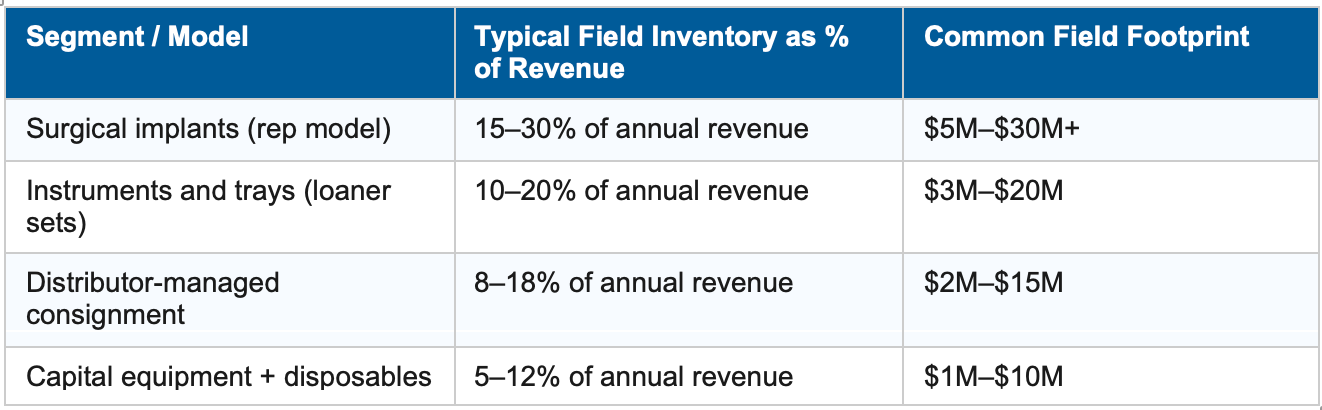
For a $50M medtech company, this means $7.5M–$15M in field inventory — a significant working capital commitment that deserves the same financial discipline applied to any other major asset class.
Why ERP and Spreadsheets Fail at Field Inventory Management
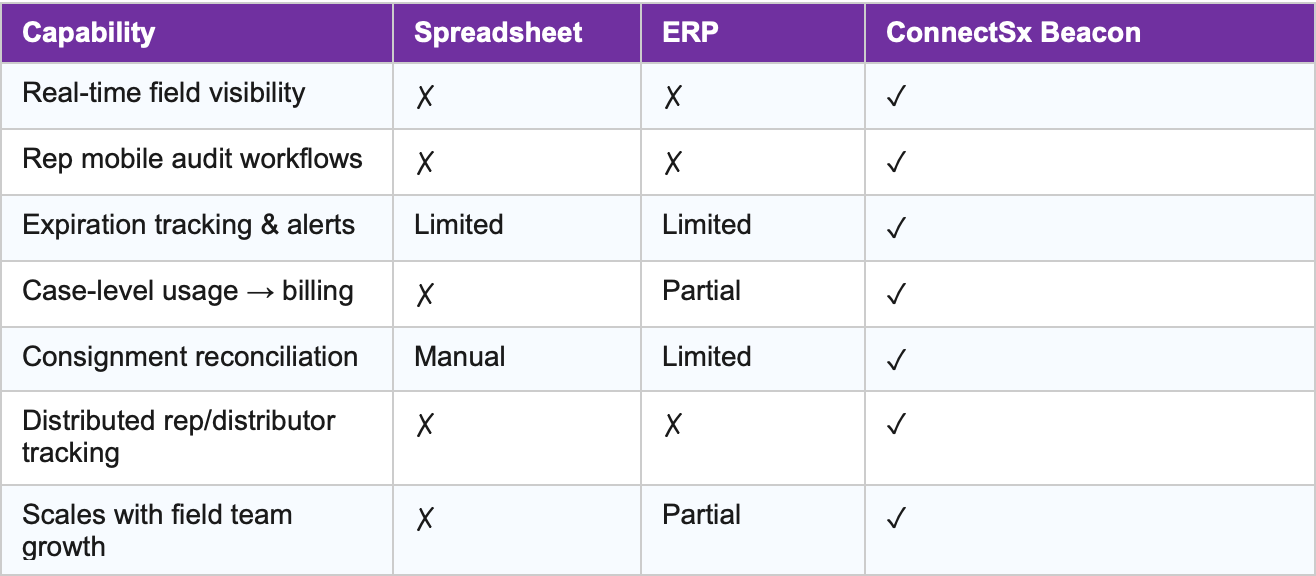
Before building the ROI case for dedicated field inventory management software, it helps to understand why the two most common alternatives fall short. This is the evaluation question most operations teams face: do we extend what we have, or invest in purpose-built tooling?
Why ERPs Fall Short
Enterprise resource planning systems are designed to manage warehouse and internal inventory — goods that move through defined locations in a controlled environment. Field inventory breaks every assumption an ERP makes:
- No real-time distributed tracking: ERPs update inventory when product ships or returns, not when it moves between reps, consignment sites, or surgical cases.
- No field-level visibility: You can see what left the warehouse but not where it is now, how it has been used, or when it expires in the field.
- No billing integration at case level: ERPs do not connect procedure-level usage data to invoicing in real time, creating the gap where billing leakage lives.
- No rep-facing mobile workflow: ERPs are back-office systems not designed for field use, meaning reps default to workarounds — which are almost always spreadsheets.
Why Spreadsheets Break at Scale
Spreadsheets are the default for most field teams, and they work — until they don't. The specific failure modes matter:
- Version control: Multiple reps, multiple files, no single source of truth. Reconciliation becomes a project rather than a process.
- No real-time updates: A spreadsheet reflects the state of inventory the last time someone updated it — which could be days or weeks ago.
- No expiration alerts: Manual tracking of lot numbers and expiration dates at scale is error-prone and rarely comprehensive.
- No billing connection: Usage captured in a spreadsheet must be manually transferred to finance for billing — creating delay, errors, and leakage.
- No audit trail: Spreadsheets cannot reliably track chain of custody, usage history, or reconciliation status across a distributed field team.
The Right Tool for the Job
Typical ROI Benchmarks for Medical Device Field Inventory Management Programs
One of the most common questions from operations and finance leaders evaluating field inventory management software is: what results should we realistically expect? The benchmarks below are drawn from field inventory program implementations across medtech companies of varying sizes and business models.
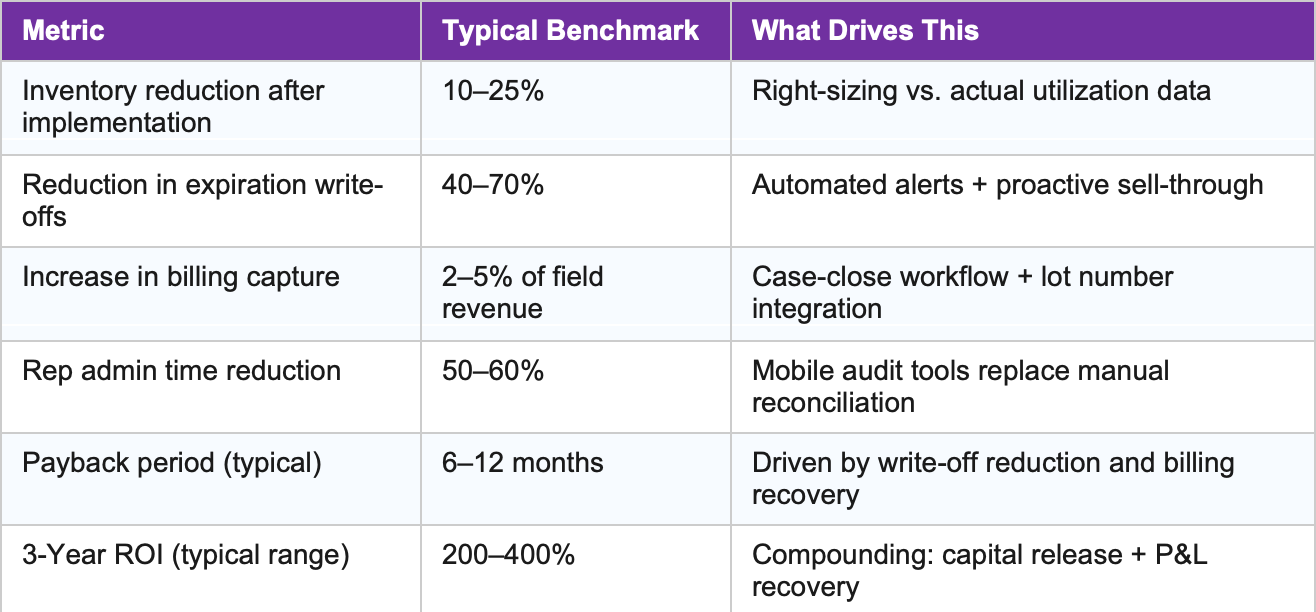
Field Inventory ROI in Practice: A mid-market medtech company with $10M in field inventory that achieves a 15% inventory reduction, 50% expiration recovery, and 3% billing improvement can expect $800K–$1.4M in annual financial benefit — against a platform investment that typically runs $100K–$250K annually. That is a 3–10x return in Year 1 alone.
—>Calculate the ROI of Implementing Beacon with our FREE ROI Calculator
Brendan Sweeney
ConnectSx Team
Ready to streamline your operations?
See how Beacon can transform your medical device workflows.