7 Brutal Truths About Medical Device Data Standards: Why AI Fails Without Them

Artificial intelligence is rapidly spreading through the medical device industry. Operations leaders, supply chain executives, and commercial teams rely on algorithms to forecast demand, automate field inventory tracking, and streamline surgical case billing.
However, a fundamental flaw threatens these initiatives: AI systems depend entirely on medical device data standards.
When catalog numbers vary across sales channels, lot numbers contain typos, Unique Device Identifiers (UDIs) fail to scan, or facility names exist under five different aliases, adding AI does not repair the breakdown. It merely accelerates errors, distributing bad information across your commercial enterprise faster than ever.
Here are seven reasons why point-of-entry data governance matters, how competing software platforms get it wrong, and why ConnectSx Beacon prioritizes strict data enforcement before deploying artificial intelligence.
1. The Dangerous Trap of "Garbage In, Faster Garbage Out"
The modern medical device enterprise runs on massive volumes of transactional data. When companies introduce artificial intelligence without establishing rigorous medical device data standards, they do not eliminate operational friction. They scale it.
If an inventory system holds conflicting product definitions, an AI algorithm will generate demand forecasts based on incorrect math. If a sales rep logs a surgical case using an unverified catalog number, an AI billing assistant will generate an inaccurate invoice.
AI cannot divine intent from corrupt inputs. If the underlying database lacks structure, machine learning models merely hallucinate solutions or surface flawed trends.
2. Why Medical Device Data Demands Zero Ambiguity
Unlike standard consumer goods, medical devices carry heavy regulatory requirements and direct patient safety implications. The industry cannot afford approximate data.
Every item moving through a field inventory network requires strict data hygiene across core fields:
- Catalog Numbers must remain identical across field inventory apps, ERP systems, and distributor feeds.
- Lot and Serial Numbers must stay attached to the exact physical item from manufacture through implantation.
- UDI Components must accurately reflect official FDA Global Unique Device Identification Database (GUDID) records.
- Expiration Dates must be locked and automated to prevent expired devices from entering operating rooms.
- Facility and Customer Names must resolve to a single canonical entity, regardless of local rep naming conventions.
When facility aliases multiply or expiration dates are miskeyed, errors cascade through the enterprise. Chargebacks get rejected, inventory audits fail, sales reporting degrades, and recall tracing requires days of manual forensic research.
3. The Competitor Flaw: Supporting Messy Data Standards with "AI Cleanup"
Many medical device inventory platforms attempt to solve data messiness after the fact. They market machine learning tools designed to clean up messy spreadsheets, auto-correct mismatched product codes, or smooth over duplicate facility records long after the transaction completes.
This approach fails because it treats the symptom rather than the cause. Supporting loose medical device data standards creates permanent operational drag.
| Operational Approach | Data Ingestion Method | Downstream Impact |
|---|---|---|
| Legacy / Competitor Systems | Accepts unstructured field data; relies on post-transaction AI cleanup | High risk of hallucinations, misallocated inventory, and audit failures |
| ConnectSx Beacon | Enforces validation rules and scanning at the point of action | Clean database foundation, automated compliance, and trustworthy AI insights |
Relying on artificial intelligence to clean up unstructured, unvalidated field data introduces structural risk:
- Inaccurate Entity Matching: An algorithm guessing whether "St. Mary's OR," "Saint Mary Hospital," and "St. Mary's Health" are the same account will eventually misallocate inventory or credit the wrong sales territory.
- Compounded Regulatory Risk: If an AI model infers a lot number based on historical trends rather than verifying the physical barcode scan, audit trails become legally undefendable.
- Persistent Operational Drag: Operations teams end up spending hours auditing the output of the cleanup algorithms, creating a secondary layer of manual review.
4. Why Data Standards Must Be Enforced at the Point of Entry
High-quality data is not created by periodic database maintenance or quarterly cleanup sprints. It is achieved by enforcing rigid medical device data standards at the precise moment information enters the ecosystem.
This requires operational software designed to prevent bad data from reaching the database in the first place.
Essential point-of-entry controls include:
- Mandatory Barcode Validation: Requiring optical or RFID scanning of 2D matrix UDI codes rather than manual typing.
- Strict Schema Enforcement: Rejecting entries that miss lot numbers, serial numbers, or mandatory expiration fields.
- Automated Alias Resolution: Forcing field users to select pre-approved, master-data-managed facilities and accounts.
- Real-Time Exception Handling: Prompting the user to fix an anomaly immediately before the transaction completes.
Preventing dirty data from entering the system eliminates the need to algorithmically salvage it later.
5. Maintaining Traceability and Chain of Custody Across Field Networks
Medical device inventory moves through a complex, decentralized distribution web. Stock travels from manufacturing hubs to 3PL warehouses, transfers to sales rep trunk stock, sits on hospital consignment shelves, and shifts between field reps during emergency surgical cases.
Without unbroken chain-of-custody tracking, operational visibility evaporates.
A comprehensive inventory workflow must answer key operational questions in real time:
- Where is the physical device located right now?
- Who had custody of the item during each transfer?
- What is the current shelf-life status of the product?
- Was the device transferred, returned, consumed in a surgical case, or written off?
When every transaction enforces standardized data capture, management gains a reliable audit trail instead of an estimate.
6. How ConnectSx Beacon Enforces Data Integrity First
ConnectSx Beacon takes a different path from legacy platforms. Beacon operates on a fundamental principle: enforce data integrity at the point of action, then deploy AI to analyze and optimize.
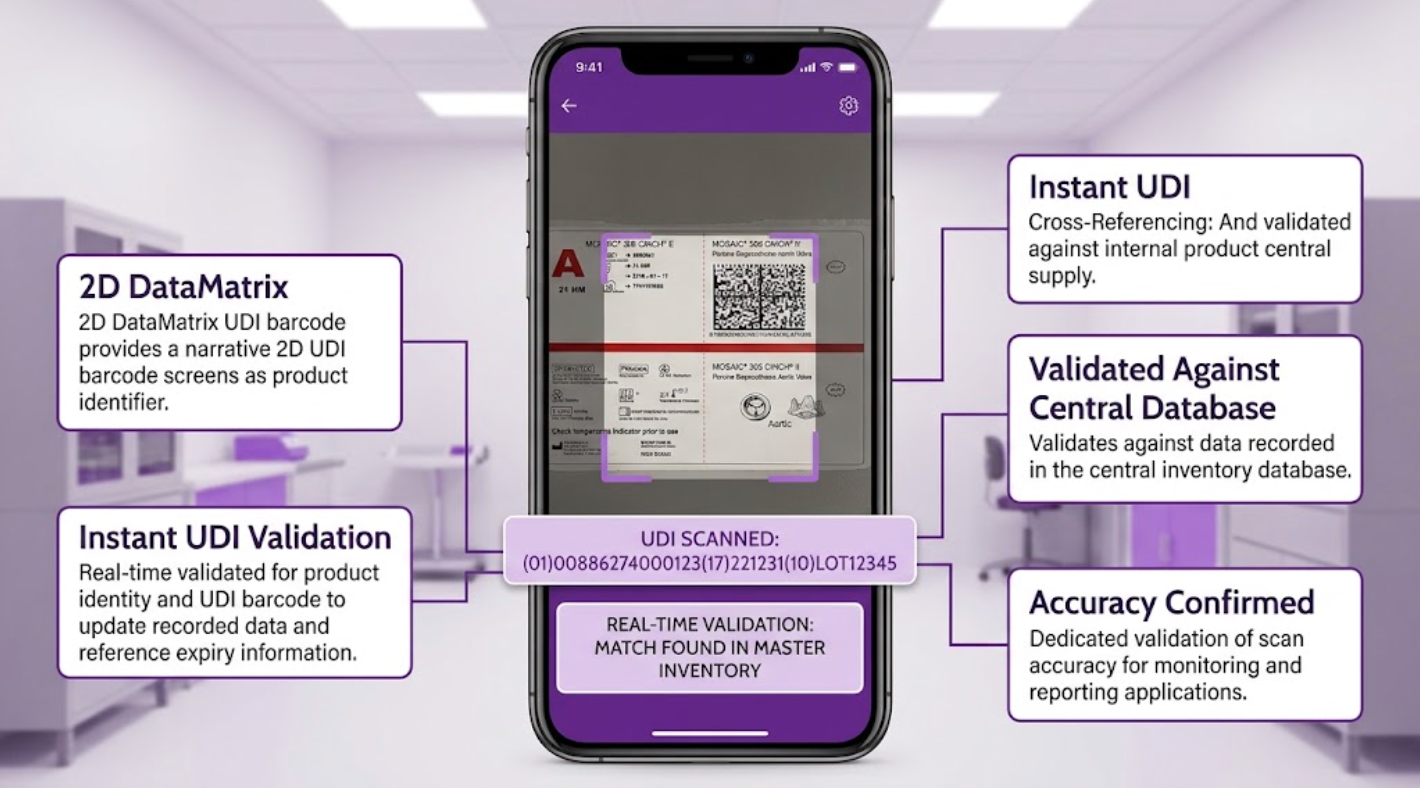
ConnectSx Beacon embeds strict medical device data standards directly into field sales and inventory workflows:
- Native UDI Capture: Beacon uses mobile scanning to capture and parse FDA UDI data instantly, validating product IDs, lot numbers, and expiration dates against master data.
- Master Data Mapping: Accounts, surgical facilities, and sales reps exist within a single source of truth, removing duplicate entity creation in the field.
- Guided Operational Workflows: Field reps follow structured workflows for trunk transfers, consignment audits, and case consumption, ensuring no required field is skipped.
- Integrated Chain of Custody: Every inventory movement creates an immutable log, linking physical movements directly to financial and clinical records.
Once this clean foundation is locked in, Beacon utilizes artificial intelligence to deliver high-value insights: predicting stockouts, recommending field inventory rebalancing, identifying trunk stock hoarding, and automating replenishment.
Because the AI acts on standardized data, leadership can trust the output completely.
7. Controlled Data Drives True Operational Intelligence
No medical device enterprise operates with 100% perfection. Human error occurs, surgical schedules shift, and field transfers happen in high-pressure environments.
The key distinction lies in how your software platform responds to human error:
- Lax Systems allow bad records into the ERP, hoping downstream AI or manual cleanup teams catch the errors later.
- Controlled Systems like ConnectSx Beacon catch irregularities at the point of entry, enforce the correct protocol, and maintain data integrity.
Building an AI-driven commercial operations strategy requires establishing structural medical device data standards first. When product catalogs are synchronized, inventory movements are traceable, and entity records are locked, artificial intelligence becomes an operational multiplier rather than a source of confusion.
ConnectSx Beacon stands out as the premier industry partner because it was purpose-built to enforce medical device data standards directly within daily field workflows. Instead of relying on risky post-transaction cleanup or algorithmic guesswork, Beacon captures and validates UDI, lot, and facility records in real time at the precise point of action. By establishing an uncompromised source of truth from day one, Beacon enables your commercial operations to deploy AI tools with absolute confidence and total regulatory compliance. Partner with ConnectSx to eliminate operational data debt and transform your field inventory logistics into a seamless, competitive advantage.
Ready to streamline your operations?
See how Beacon can transform your medical device workflows.