Medical Device Inventory Management Improvements Without New Software: 7 Quick Fixes

You know your medical device inventory management processes aren't working. Cases get miscounted. Field reps chase down expired product. Operations spends Monday morning doing what Friday afternoon should have handled automatically.
But right now, a new software system isn't in the cards. Budget is frozen, IT has a 12-month backlog, or leadership needs a stronger ROI case before signing off.
Here's the thing: you can make meaningful medical device inventory management improvements without buying anything new. With the right structure and discipline, you can dramatically reduce errors, improve visibility, and build an operational foundation that will serve you now — and simplify your transition to a platform when the time comes.
Important caveat before we start: these fixes improve performance within the inherent limits of manual systems. They don't change those limits. A spreadsheet made better is still a spreadsheet. We'll be honest throughout about where each fix has a ceiling — and why that ceiling exists.
Who This Article Is For
This guide is written specifically for:
- Medical device companies currently managing inventory in spreadsheets, shared drives, or printed forms
- Operations and supply chain teams not yet ready to invest in dedicated inventory software
- Field sales and logistics managers trying to reduce errors and expiration risk without new tools
- Leaders building the business case for a platform investment and needing to show improvement in the meantime
If you're managing 50–500+ active SKUs across multiple reps or locations and feeling the strain, this is for you.
The Hidden Cost of Poor Medical Device Inventory Management (Even Without Buying Software)
Before we get to the fixes, it's worth naming what poor inventory management actually costs — because the case for improvement isn't just operational, it's financial.
- Expired product waste: Industry estimates suggest medical device companies lose 2–5% of total inventory value annually to expiration-related write-offs. For a $5M inventory, that's $100K–$250K per year.
- Stockout costs: A single delayed or cancelled case due to missing product can cost $5,000–$50,000+ in lost revenue, not counting the relationship damage with the surgical team or hospital.
- Labor waste: Operations teams managing manual inventory systems commonly spend 15–25% of their weekly hours on reconciliation tasks that a structured system — or a platform — would eliminate entirely.
- Compliance exposure: Manual lot tracking errors create UDI compliance risk. A recall response that takes days instead of hours is not just operationally painful — it's a regulatory liability.
- Shadow systems: When reps and managers don't trust the official inventory data, they create their own spreadsheets. Now you have two broken systems instead of one.
These costs accumulate silently. They don't appear as a line item until an audit, a write-off, or a missed case. The inventory management improvements below are designed to start reducing all of them — today.
7 Medical Device Inventory Management Improvements Without New Software
Each fix includes specific implementation steps and an honest assessment of where it hits its limits.
Quick Inventory Fix #1: Create a Single Source of Truth (Without New Software)
If your team references more than one spreadsheet as "the current one," you've already lost. Conflicting versions are the single biggest source of downstream errors in manual medical device inventory management.
How to implement it:
- Designate one file as the master — stored on a shared drive with a locked naming convention (e.g., "MASTER_Inventory_LIVE — DO NOT DUPLICATE")
- Include every SKU with fields for lot number, expiration date, location code, reorder threshold, and case assignment history
- Link to (never copy) supplier contact tabs and regional location breakdowns
- Restrict edit access to one person or role. Everyone else reads. Changes flow through one gate.
The ceiling: One master file works well with a small, disciplined team. As rep count grows and case volume increases, the file becomes a bottleneck — edits queue up, versions drift, and the "single source" becomes unreliable through sheer access volume. A platform solves this by replacing the file with a real-time database every user writes to simultaneously.
Quick Inventory Fix #2: Apply Structured Data Entry Controls to Reduce Errors
Free-text fields are entropy engines in medical device inventory management. Every person who types "lot number" differently — "Lot#," "LOT," "L#" — creates a reconciliation problem that compounds over time.
How to implement it:
- Apply dropdown validation on all categorical fields: rep name, region, location code, product category
- Use conditional formatting to flag blank required fields in red before a record is considered complete
- Add a formula-based "completeness score" column showing what percentage of required fields are populated
- Lock all formula columns to prevent accidental overwriting
The ceiling: Validation controls reduce errors but can't catch wrong values that are technically valid — e.g., selecting the right rep name for the wrong location. And they only work when your team is actually entering data into the master file. Field reps logging from their phone, mid-case, will find workarounds. Platforms solve this with mobile-native forms that enforce compliance at the point of use.
Quick Inventory Fix #3: Set Up Automated Alerts for Inventory Management Without New Software
The most common failure mode in manual medical device inventory management isn't bad intentions — it's information falling through the cracks. Automated notifications create a rhythm that doesn't depend on anyone remembering.
How to implement it:
- Use Google Sheets + Apps Script (or Excel + Power Automate) to send automated email alerts when items approach reorder thresholds or expiration windows
- Create recurring Slack or Teams reminders for weekly count assignments
- Build a Google Form for field reps to log inventory events — receipts, transfers, returns — that feeds directly into your master sheet
- Set expiration alert windows at 120, 90, and 60 days to give enough lead time to act
The ceiling: Spreadsheet automation breaks at scale and breaks silently — a formula error or permissions change can kill alerts for weeks before anyone notices. It also can't push alerts to mobile or integrate with case scheduling systems. Platform automation is persistent, auditable, and triggered by system events rather than formula conditions.
Quick Inventory Fix #4: Build a Reorder Engine for Proactive Medical Device Inventory Management
Reactive restocking is one of the most expensive operational patterns in medical device distribution. You don't need predictive AI to get ahead of it — you need well-designed formulas and a standing process.
How to implement it:
- Add a "Days Until Reorder" column: =(Current Quantity − Reorder Threshold) ÷ Average Daily Usage
- Flag items where days-until-reorder is less than supplier lead time — these need attention now
- Build a linked "Order Request" tab that auto-populates supplier name, SKU, and quantity needed based on flagged items
- Review this tab in a 15-minute standing Monday morning operations meeting — same time, every week
The ceiling: Formula-based reorder engines assume stable usage rates, which medical device inventory often doesn't have. Surgical volume fluctuates by week, season, and rep activity. A platform calculates reorder points dynamically based on actual case history — your spreadsheet uses last month's average regardless of what happened this week.
Quick Inventory Fix #5: Replace Year-End Audits With Rolling Medical Device Inventory Cycle Counts
Annual physical inventory counts are a disaster waiting to happen. By the time you audit, discrepancies have been compounding for 12 months. Rolling cycle counts surface problems in near real-time.
How to implement it:
- Divide your full inventory into 4–8 segments by location, product category, or rep territory
- Assign each segment to a rotating weekly or biweekly schedule — every SKU gets verified at least once per quarter
- Use printed count sheets for the physical count, then reconcile digitally against your master file within 24 hours
- Log all variances in a dedicated discrepancy tab with a mandatory "root cause" column to surface patterns over time
The ceiling: Printed count sheets create no searchable audit trail. A compliance auditor asking for lot-level chain of custody going back 18 months will get a folder of scanned PDFs — not exactly audit-ready. Platforms log every count, every variance, and every resolution automatically, with timestamps and user attribution.
Quick Inventory Fix #6: Standardize Trunk Stock and Consignment Protocols for Medical Device Field Teams
For medical device companies, the field is where inventory goes to disappear. Trunk stock and consignment inventory managed informally — through texts, emails, or rep memory — is one of the costliest blind spots in the industry.
How to implement it:
- Create a standardized Field Inventory Log template every rep submits within 24 hours of a case — same fields, same format, every time
- Establish a weekly trunk reconciliation ritual: reps self-report their current on-hand against expected inventory
- Set a maximum trunk float per rep and flag overages in your master file for management review
- Document all consignment contracts and expiration policies in a dedicated tab with clear ownership and review dates
The ceiling: Trunk reconciliation via self-reporting is only as accurate as rep compliance. When reps are busy, forms get skipped. Discrepancies accumulate. A platform provides real-time field visibility without requiring rep data entry — inventory moves are recorded at the point of transfer, not reconstructed later.
Quick Inventory Fix #7: Build a Leadership Dashboard for Medical Device Inventory Visibility
Leadership shouldn't have to dig through raw spreadsheet tabs to understand inventory health. A simple summary view — even in a spreadsheet — changes how the organization engages with inventory data and builds the internal confidence needed to fund future improvements.
How to implement it:
- Build a "Dashboard" tab at the front of your master file with summary metrics: total SKUs, items below reorder threshold, items expiring within 90 days, open discrepancies
- Use color-coded conditional formatting so red/yellow/green status is visible without reading numbers
- Share this dashboard via email every Monday morning — 60 seconds of copy/paste, every week, without fail
- Track three trends month-over-month: error rate, expiration write-offs, and fulfillment delays
The ceiling: A spreadsheet dashboard is a lagging indicator — it shows you what happened, not what's happening. By the time the dashboard flags an expiration issue, the product may already be in the field. Platforms provide live visibility, not weekly snapshots.
How to Implement These 7 Quick Inventory Fixes in 60 Days
Don't try to do all of this at once. Here's a staged rollout that builds momentum without overwhelming your team:
Weeks 1–2: Foundation
- Designate and lock your master inventory file (Fix #1)
- Apply dropdown validation and completeness scoring (Fix #2)
- Audit your current SKU list — archive anything inactive
Weeks 3–4: Automation and Reorder
- Set up expiration and reorder alert emails or Slack triggers (Fix #3)
- Build the formula-based reorder engine and schedule the Monday review (Fix #4)
Weeks 5–8: Field Ops and Visibility
- Launch the standardized Field Inventory Log and trunk reconciliation protocol (Fix #6)
- Begin the first cycle count rotation (Fix #5)
- Build and distribute the leadership dashboard (Fix #7)
At 60 days: Review error rates, expiration write-offs, and reconciliation time. If these haven't improved meaningfully, your problems are structural — not procedural. That's the signal that a platform is the right next step.
What These Fixes Look Like in Practice
Consider a regional medical device distributor managing 8 field reps across a 3-state territory. Before implementing these fixes, the team was spending roughly 12–15 hours per week on inventory reconciliation, writing off an estimated 3–4% of inventory annually to expiration, and running on three competing "master" spreadsheets that each rep had customized.
After applying fixes #1 through #5 over a 45-day period:
- Reconciliation time dropped to under 5 hours per week
- Expiration write-offs fell significantly in the first full quarter — mostly because the 120-day alert window gave enough lead time to redeploy product
- The team eliminated two of the three competing spreadsheets and built stakeholder trust in a single source of truth for the first time
The remaining friction? Field visibility. Trunk reconciliation via weekly self-reporting still created gaps. That's the problem that eventually drove the conversation about Beacon — and exactly the kind of friction that a purpose-built platform is designed to solve.
Manual Inventory vs. Dedicated Platform: What Changes?
Use this table to understand where structured manual processes hit their ceiling — and what a dedicated medical device inventory management platform changes.
These aren't reasons to buy a platform today — they're honest markers for when you'll outgrow what manual inventory management improvements can deliver. When multiple rows in this table represent active pain points for your team, the math on a platform investment changes.
These Fixes Work — Until They Don't
Every fix above has a ceiling. That ceiling isn't a failure of process design — it's the fundamental architecture of manual systems. Spreadsheets scale linearly with headcount. Every new SKU, rep, and location adds coordination overhead that no process improvement can fully absorb.
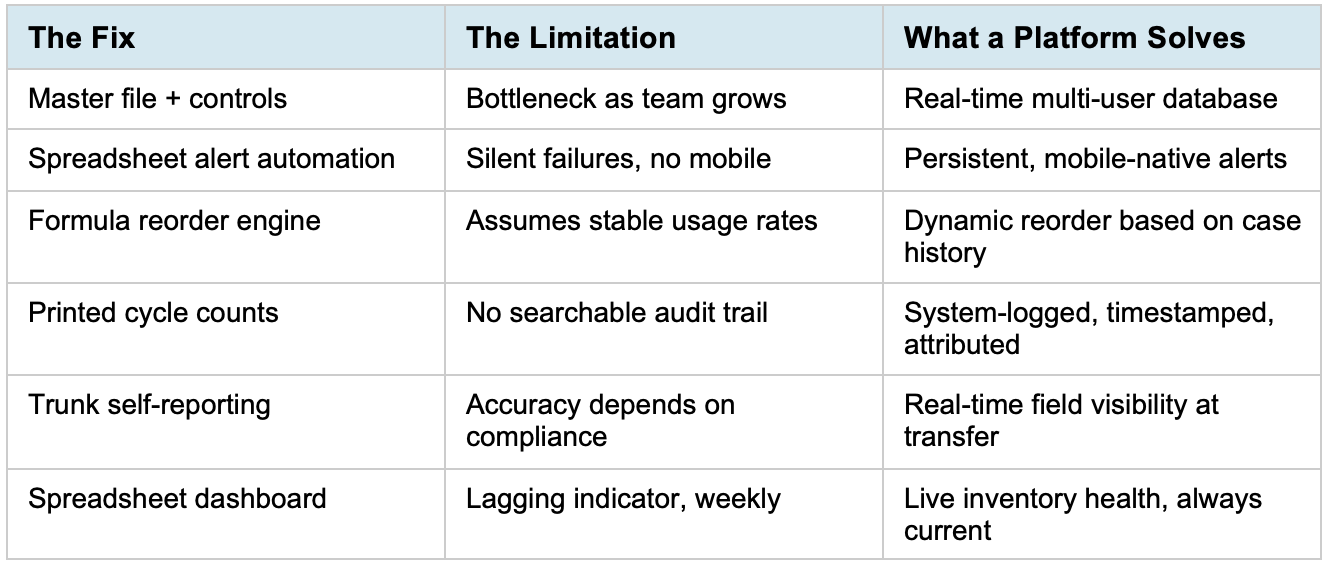
Here's how the upgrade path maps from fix to limitation to platform solution:
When you're ready to close that gap, Beacon is built specifically for the medical device companies making this transition. It's designed for teams that have outgrown spreadsheets and need field-to-office inventory visibility, UDI compliance, and consignment reconciliation — without the implementation overhead of an enterprise ERP.
→ Learn more about the Beacon platform → Take the Readiness Assessment
FAQ: Medical Device Inventory Management Without New Software
What should I do if I'm not ready to buy inventory management software?
Focus on the three pillars of manual improvement: data integrity, process consistency, and visibility. Data integrity means one master file with structured input controls. Process consistency means documented, repeatable workflows for receiving, transfers, cycle counts, and returns — trained across your entire team. Visibility means a regular reporting cadence that gives leadership reliable inventory health data without digging through raw files.
The goal is to stop treating your manual system as a temporary workaround and start treating it as a real system with real standards. That discipline reduces errors now and dramatically simplifies your eventual transition to a platform.
When should I upgrade to inventory management software?
Watch for these inflection points — each one signals that you've outgrown what manual processes can reliably support:
- A compliance audit or FDA inspection reveals traceability gaps that took days to reconstruct
- Field reps consistently work from outdated information because the master file can't update fast enough
- You've hired staff specifically to manage inventory reconciliation rather than to grow the business
- A product recall or lot withdrawal would take 48+ hours to execute cleanly
- You're managing more than 300–500 active SKUs across multiple locations or reps
- Revenue is being lost to expired inventory, unfulfilled cases, or overstock not visible in real time
Any one of these is a meaningful signal. Multiple at once means the cost of your current system is higher than the cost of replacing it.
How do I know when my current inventory management processes are not enough?
There's a practical test: implement the seven fixes in this article and measure your error rate, expiration write-offs, and reconciliation time at 60 days. If those metrics haven't improved meaningfully, your problems are structural — not procedural — and no amount of spreadsheet optimization will close the gap.
Additional indicators that your processes have hit their ceiling:
- Your best people spend more than 20% of their time on inventory reconciliation
- You can't answer "where is product X, lot Y right now?" in under 5 minutes
- Your error rate on case documentation has stayed flat or increased despite process work
- Sales leadership maintains shadow spreadsheets because they don't trust the official data
Can I make meaningful medical device inventory management improvements without any new technology?
Yes — and the improvements can be significant, particularly for teams in the 50–200 SKU range with fewer than 10 field reps. The seven fixes in this article can reduce data errors, improve reorder efficiency, and give leadership reliable visibility into inventory health.
But "meaningful" has limits. Manual systems scale linearly with headcount. Every new SKU, rep, and location adds coordination overhead that process discipline alone can't fully absorb. The ceiling is real — the question is when you'll hit it, not whether you will.
Are these fixes enough for UDI compliance and regulatory audits?
They help — but they don't fully solve it. Structured lot tracking, consistent field logging, and documented cycle counts all support a compliance posture. But manual lot tracking carries inherent error risk, and reconstructing chain-of-custody documentation from spreadsheets during an audit is time-consuming and incomplete.
If you're operating under strict UDI compliance obligations or facing regular regulatory audits, that's one of the strongest signals that a dedicated medical device inventory management platform should be a near-term priority, not a future consideration.
The Bottom Line on Medical Device Inventory Management Improvements Without New Software
You don't have to wait for a budget cycle or an IT green light to start fixing your medical device inventory management. These seven quick inventory fixes — a master file, data controls, automated alerts, a reorder engine, cycle counts, field stock protocols, and a leadership dashboard — are available to any team today.
Implement them with intention. Measure the results at 60 days. And when the gap between what your spreadsheets can do and what your operations actually needs becomes too wide to bridge with process alone — that's the moment to have a serious conversation about Beacon.
Brendan Sweeney
ConnectSx Team
Ready to streamline your operations?
See how Beacon can transform your medical device workflows.