10 Essential QMSR UDI Requirements for 2026: A Guide to FDA Compliance & Value
10 QMSR UDI Requirements for 2026: Your Compliance Checklist for FDA's New Quality System Rule
Quick answer: Under the QMSR, which replaced the old Quality System Regulation on February 2, 2026, Unique Device Identification (UDI) is no longer a standalone labeling task — it's woven into records control, complaint handling, servicing, risk management, and software validation. Manufacturers must show FDA investigators that UDI data is accurate, traceable, and synchronized with the Global UDI Database (GUDID) across ten specific control points, detailed below.
Key Takeaways
- The deadline has passed. February 2, 2026 was the QMSR's effective date, not a future milestone. FDA is now inspecting against it using Compliance Program 7382.850.
- UDI is one of four "Other Applicable FDA Requirements" (OAFRs). Alongside Medical Device Reporting, Corrections & Removals, and Device Tracking, UDI now gets its own dedicated review track during inspections — separate from the six core QMS process areas.
- ISO 13485:2016 is the foundation, not the ceiling. The QMSR incorporates ISO 13485 by reference but retains several FDA-specific "plus" requirements — most notably §820.45 (labeling and packaging controls) and §820.35 (control of records) — that go beyond what the ISO standard requires.
- GUDID accuracy is now an inspectable record. A mismatch between your physical label and your GUDID entry is treated as a records/labeling nonconformance, not a minor clerical issue.
- This is a QMS-wide issue, not just a labeling one. UDI data now touches risk management (ISO 14971), software validation, complaint handling, and servicing — meaning Quality, Regulatory, IT, and Manufacturing all need to be aligned.
What Changed for UDI When QMSR Took Effect on February 2, 2026
The QMSR is the most significant overhaul of FDA's device quality regulations in almost three decades. It replaces the standalone Quality System Regulation (the old 21 CFR 820) with a framework built around ISO 13485:2016, which FDA now incorporates by reference rather than maintaining a parallel U.S.-only standard.
Structurally, Part 820 shrank dramatically: what used to be 15 subparts (A through N) is now just two — Subpart A (general provisions, including definitions and the core requirement to maintain a quality management system) and Subpart B (FDA-specific supplemental requirements that ISO 13485 doesn't fully cover). UDI requirements live in that second bucket. FDA's own review of ISO 13485 concluded the standard doesn't say enough about label verification, complaint and service record content, or device tracking to protect patient safety on its own — so those requirements were retained largely intact.
FDA's updated inspection manual, Compliance Program 7382.850(published February 2, 2026), replaced the older QSIT methodology and now organizes every inspection around:
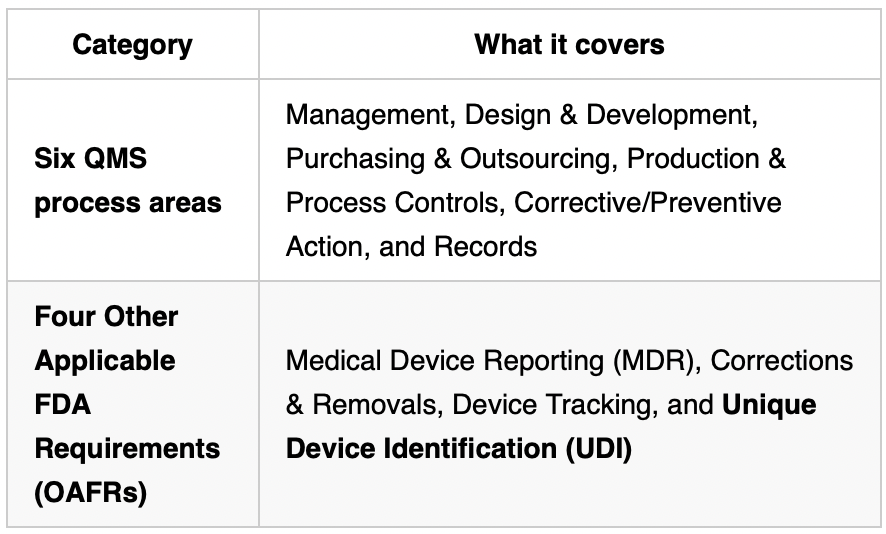
The practical implication: UDI is no longer a line item inside "labeling." It's a named inspection category with its own review steps, and investigators are trained to pull GUDID records and cross-check them against your device history files on the spot.
The 10 QMSR UDI Requirements at a Glance
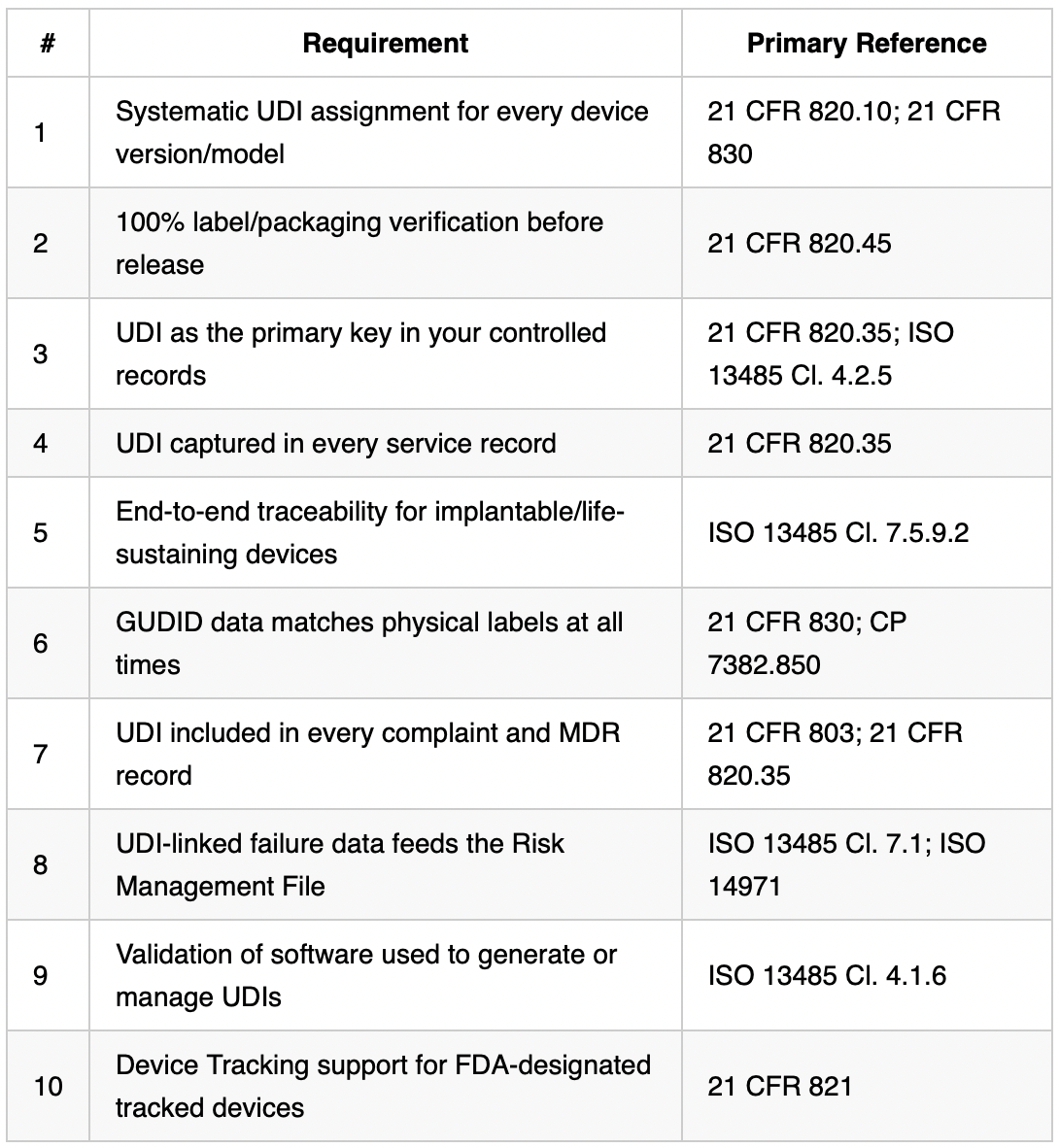
Use this table as a gap-check starting point, then work through the full explanations below before you finalize an audit plan — the citations above point to the general section; always confirm exact subsection language against the current eCFR text of Part 820 or with regulatory counsel before writing procedures.
The 10 QMSR UDI Requirements, Explained
1. Systematic UDI Assignment
Every device version or model needs a documented, repeatable process for how it receives a UDI — not an ad hoc decision made at the labeling stage. Your QMS must define who assigns UDIs, when in the product lifecycle assignment happens, and how you prevent duplicate or reused identifiers across model changes.
Reference: 21 CFR 820.10 (quality management system requirements); 21 CFR 830 (Unique Device Identification). Audit tip: Pull your device master record for your three most recently changed SKUs and confirm the UDI assignment logic is documented, not just remembered by one person.
2. Enhanced Labeling and Packaging Controls
This is one of the clearest "FDA-plus" requirements in the QMSR. Because FDA concluded ISO 13485 doesn't spell out label verification in enough detail, §820.45 survives largely intact and requires a documented, 100% accuracy check of UDI and UPC content before labels are released for use — not a sampling plan, a full check.
Reference: 21 CFR 820.45 (retained supplemental requirement). Why it matters: Labeling mix-ups were a major driver of the rulemaking. This is one of the first things investigators verify because it's easy to test on the spot.
3. UDI-Linked Record Control
Records are now unified conceptually under what many practitioners call the Medical Device File (MDF) approach, mirroring ISO 13485's records structure. The UDI or UPC must function as a primary key across your controlled records, so a device's full history — design, production, complaints, service — can be pulled by UDI alone.
Reference: 21 CFR 820.35 (control of records); ISO 13485 Clause 4.2.5.
4. Mandatory Service Record Integration
Every time a device is serviced, the specific unit's UDI must be captured in the service record. This is what makes it possible to trend maintenance and failure history at the individual-device level rather than just the model level.
Reference: 21 CFR 820.35. Audit tip: If your field service reports capture serial numbers but not UDI, that's a gap worth closing before your next inspection.
5. Traceability for Life-Sustaining and Implantable Devices
Manufacturers of implantable, life-sustaining, or life-supporting devices face the strictest traceability bar in the regulation. You must be able to trace a specific UDI from incoming components through manufacturing, distribution, and — where applicable — to the specific healthcare facility or patient.
Reference: ISO 13485 Clause 7.5.9.2, incorporated via 21 CFR 820.10. See the deep dive below for what this means operationally.
6. GUDID Data Synchronization
Any gap between your physical device label and the corresponding entry in the Global UDI Database (GUDID) is treated as a compliance failure, not a data-entry footnote. Your internal UDI data should function as a live mirror of what's publicly submitted to GUDID — some practitioners call this the "digital twin" standard.
Reference: 21 CFR 830; CP 7382.850.
7. Complaint and MDR Identification
When an adverse event triggers a Medical Device Report, the UDI of the affected unit must be included. This links post-market surveillance data directly back to a specific device identification, which speeds up root-cause and trend analysis on FDA's side and yours.
Reference: 21 CFR 803 (Medical Device Reporting); 21 CFR 820.35.
8. Risk Management Alignment (ISO 14971 Integration)
Under QMSR, risk management can't live only in design controls — it has to run through the full product lifecycle. FDA expects UDI-tagged post-market data (complaints, MDRs, service trends) to feed back into your Risk Management File on an ongoing basis. If you're collecting UDI-level failure data but it isn't reaching your risk file, you have a QMSR gap, not just a nice-to-have improvement.
Reference: ISO 13485 Clause 7.1; ISO 14971.
9. Software Validation for UDI Systems
Most manufacturers rely on labeling software, ERP modules, or dedicated UDI management platforms to generate and report identifiers. Under QMSR, any software used within the quality system — including UDI tooling — must be validated for its intended use, with a documented Validation Protocol and Validation Report.
Reference: ISO 13485 Clause 4.1.6. Audit tip: If your UDI software has been updated or patched since your last validation, that validation is likely stale.
10. Device Tracking (High-Risk Gaps)
For the specific device categories FDA designates as "tracked" under 21 CFR 821, UDI must support FDA's ability to locate every distributed unit on demand. This is distinct from general traceability — it's a separate regulatory mandate that QMSR explicitly cross-references to close any gap between ISO 13485 and existing U.S. tracking law.
Reference: 21 CFR 821, referenced within 820.10.
Traceability and Clause 7.5.9: The Impact on High-Risk Devices
If you manufacture implantable, life-sustaining, or life-supporting devices, the bar is higher than "can you find the lot number." ISO 13485 Clause 7.5.9.2 — now load-bearing under QMSR — requires a direct, unbroken link between the UDI and your traceability records at every stage: incoming components, in-process assemblies, finished goods, distribution, and, where applicable, the specific healthcare facility or patient who received the device.
The operational test FDA is now applying: in a field corrective action, can you produce a complete report by UDI on demand, not after days of manual reconciliation? If your traceability system still depends on spreadsheets, disconnected ERP exports, or paper travelers that require manual cross-referencing, that's a realistic path to a Form 483 observation under the new risk-based inspection protocol. Systems that unify UDI, production records, and distribution data in one queryable source are what investigators are now trained to expect from Class III and implantable device manufacturers specifically.

Is Your GUDID Record Inspection-Ready? A 5-Step Audit
The transition period is over. FDA investigators are actively using Compliance Program 7382.850, which names UDI accuracy as a specific target during risk-based inspections. Here's a practical starting sequence for auditing your own GUDID readiness:
- Pull a full export of your current GUDID submissions and compare it line-by-line against your internal device master data — don't rely on memory of "we submitted that correctly last year."
- Spot-check physical labels against GUDID entries for a representative sample across your product lines, prioritizing any device with a design change, labeling change, or new SKU in the past 18 months.
- Confirm your UDI assignment procedure is current and being followed, especially for any devices launched or modified since the QMSR transition began.
- Trace three recent complaints and three recent service events back to their UDI-linked records to confirm the link actually works end-to-end, not just on paper.
- Verify your UDI-generation software's validation status and confirm any updates since the last validation cycle have been re-validated.
The underlying goal for 2026 is a single source of truth: one system where UDI data stays synchronized across production, labeling, complaint handling, and regulatory reporting, rather than four separate systems that occasionally get reconciled.
Frequently Asked Questions: QMSR UDI Requirements
Do I need to re-label existing inventory to meet the QMSR deadline? Generally, no. Devices already in the distribution chain, along with legacy devices under previous UDI compliance date schedules, are not retroactively affected. New production and any modifications made after February 2, 2026 must follow QMSR-aligned procedures, including the enhanced label verification steps under §820.45.
How does QMSR change GUDID reporting itself? The GUDID submission mechanism hasn't changed. What's changed is that your quality system must now treat GUDID entries as a critical, inspectable record. A discrepancy between your physical label and your GUDID entry found during an inspection is cited as a records/labeling nonconformance under QMSR, not handled as an informal correction.
Is ISO 13485 certification enough to prove QMSR compliance? Not on its own. ISO 13485 is the foundation, but FDA layered several "plus" requirements on top — most notably §820.45 for label verification and §820.35 for record content — that are more prescriptive than the ISO standard alone. Your UDI program needs to demonstrably cover both the ISO clauses and these FDA-specific sections.
What's the difference between UDI traceability (Clause 7.5.9) and Device Tracking (21 CFR 821)? Traceability under ISO 13485 Clause 7.5.9 is a general quality system expectation that applies most strictly to implantable and life-sustaining devices. Device Tracking under 21 CFR 821 is a separate, narrower legal mandate that applies only to specific device categories FDA formally designates as "tracked," where the goal is FDA's ability to locate every distributed unit, not just your internal traceability.
Does QMSR apply to Class I devices? Yes — QMSR applies across device classes, though the intensity of FDA's UDI review during inspection tends to track device risk. Class I devices generally carry lower traceability and tracking burdens than implantable or life-sustaining devices, but the core UDI assignment, labeling, and GUDID-accuracy requirements still apply.
Who owns UDI compliance inside an organization — Quality or Regulatory?Both, in practice. UDI assignment and GUDID submission are usually Regulatory Affairs functions, while label verification, record control, and service record integration sit within Quality. Because QMSR now links UDI data to risk management and software validation as well, IT and Manufacturing typically need to be involved too. Treating UDI as a single-owner task is one of the more common gaps found during 2026 inspections.
What happens if we find a GUDID discrepancy during our own audit? Document the discrepancy, correct the GUDID entry or the physical label as appropriate, and record the corrective action in your quality system — ideally before an FDA inspection finds it first. A documented, self-identified correction is treated very differently than an investigator finding the same gap during an inspection.
Strategic Value: Turning Compliance into Operational Data
Meeting the QMSR UDI requirements is a defensive necessity, but manufacturers who go further — treating UDI as a live operational data stream rather than a barcode — tend to see returns beyond avoiding a Form 483:
Faster recall execution becomes possible when you have real-time visibility into which lots and units are affected, which narrows both the scope and cost of a recall event. Postmarket surveillance improves because UDI-linked adverse event data supports more accurate trend analysis and feeds directly into design iterations. Inventory accuracy improves because a UDI system that bridges the warehouse and the point of care makes it easier to ensure the right device is in the right place — which matters as much for supply chain efficiency as it does for compliance.
Conclusion: The Road Ahead for Medical Device Labeling
The shift to QMSR is the most significant change to FDA's device quality regulations in nearly 30 years, and UDI sits at the center of it — not as a labeling afterthought, but as connective tissue running through records control, complaint handling, servicing, risk management, and software validation. The ten requirements above are a practical checklist for validating your QMS against the framework FDA is now actively inspecting under Compliance Program 7382.850.
February 2, 2026 was the start of enforcement, not the finish line. The organizations best positioned going forward are the ones that treat UDI as a single, synchronized source of truth across production, labeling, and regulatory reporting — rather than a compliance box checked once a year.
Beacon’s Advantage: Turning UDI Into Actionable Insight
Beacon goes beyond basic UDI compliance to make UDI data usable across the entire supply chain. Every device tracked in Beacon carries its UDI through to the point of use, appearing automatically on bill sheets and case documentation. This ensures billing accuracy, supports full traceability, and simplifies recall readiness.
Beacon also layers in expiration management and full inventory visibility, so operations teams can prevent wasted stock, avoid expired implants reaching the OR, ensure your systems support you in the event of a recall, and maintain confidence that the right device is in the right place at the right time. With Beacon, UDI isn’t just a regulatory requirement—it’s a foundation for smarter, leaner operations. To see how much Beacon can save an operation like yours, try out our free ROI Calculator.
This article is for general informational purposes and reflects publicly available FDA guidance as of August 2026. It is not legal advice. Confirm current regulatory text and applicability to your specific devices with qualified regulatory counsel or directly against the eCFR.
Sources
- Quality Management System Regulation (QMSR) – FDA
- Quality Management System Regulation – Frequently Asked Questions – FDA
- Compliance Program 7382.850, Inspection of Medical Device Manufacturers – FDA
- eCFR: 21 CFR Part 820 — Quality Management System Regulation
- eCFR: 21 CFR 820.35 — Control of Records
- AccessGUDID – National Library of Medicine
Brendan Sweeney
ConnectSx Team
Ready to streamline your operations?
See how Beacon can transform your medical device workflows.